How to Write a Book: Writing Tips for Beginners
BOOK WRITING
You don’t need to be an experienced writer to write a book. You need an idea, a reader you want to reach and a practical way to turn that idea into a finished manuscript.
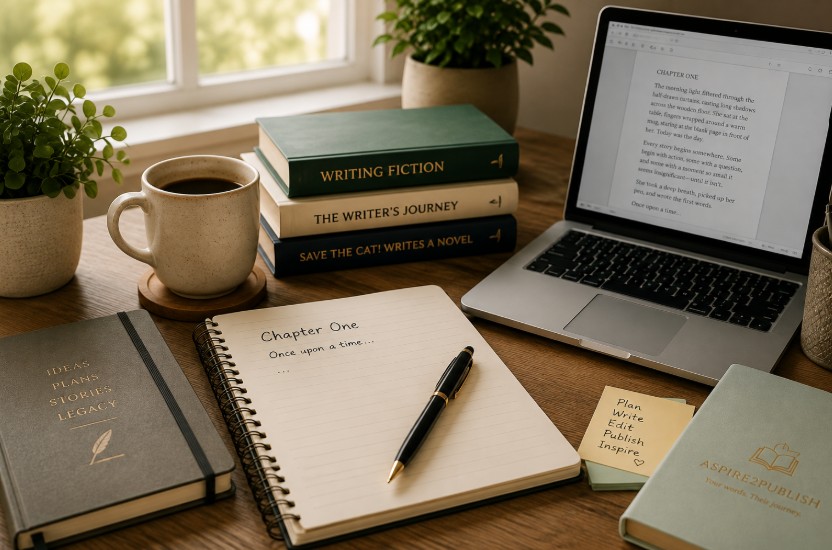
For many aspiring authors, writing a book begins with a thought that refuses to disappear.
Maybe you have a story you’ve wanted to tell for years. Perhaps you’ve developed knowledge through your career or experiences that could help other people. Or maybe you simply have an idea for a book and keep thinking, I’d love to write that someday.
Then comes the difficult part: actually writing it.
A blank document can make writing a book feel enormous. How long should it be? Where do you start? Do you need an outline? What if your writing isn’t good enough? Should you edit as you go? And how do you keep writing when the initial excitement wears off?
The good news is that you don’t need to have the entire process figured out before you begin.
Writing a book becomes much more manageable when you stop thinking about creating an entire book and instead focus on completing one stage at a time.
This guide will walk you through the process, from developing your initial idea to finishing a manuscript you’re ready to edit and eventually publish.
1. Start With Why You Want to Write a Book
Before thinking about chapters, word counts or publishing, take some time to understand why you want to write this particular book.
Your reason doesn’t have to be profound. But knowing it can help guide hundreds of decisions you’ll make later.
You might want to:
- entertain readers with a story
- share knowledge or expertise
- teach people how to do something
- document an experience
- build credibility in your profession
- support an existing business
- create an additional source of income
- fulfil a lifelong ambition to become a published author.
Your motivation matters because different goals can lead to very different books.
Someone writing a practical book to support their consulting business may approach their topic differently from someone writing a memoir for their family. A novelist hoping to build a long-term fiction career may make different decisions from someone who simply wants to publish the story they’ve always dreamed of writing.
Try completing this sentence:
I want to write this book because ____________________.
Keep the answer somewhere visible. You’ll probably appreciate the reminder later in the writing process.
2. Define What Your Book Is Really About
Having a book idea isn’t quite the same as knowing what your book is about.
Many first-time authors begin with an idea that’s simply too broad.
For example: Business is a subject.
How small service businesses can build simple systems that allow the owner to step away from daily operations is a book idea.
Likewise: A fantasy novel about magic is broad.
A young healer discovers the magic she’s been hiding is the only thing capable of saving the kingdom that outlawed it gives the story direction.
Before writing thousands of words, try explaining your book in one or two sentences.
For nonfiction, ask:
What will this book help the reader understand, achieve, solve or change?
For fiction, ask:
Who is this story about, what do they want and what stands in their way?
Don’t worry about creating the perfect book description yet.
The purpose is simply to give your manuscript a centre of gravity.
When you’re deciding whether an idea, chapter, scene or story belongs in the book later, you can return to this central concept and ask: Does this help deliver the book I promised to write?
3. Know Who You’re Writing For
One of the most useful things you can do before writing your book is decide who you want to read it.
Trying to write for “everyone” usually makes writing harder, not easier.
Imagine you’re writing a book about personal finance.
Advice written for a university student opening their first investment account would probably look very different from advice written for someone approaching retirement.
The same principle applies to fiction.
A cosy mystery reader arrives with different expectations from a reader opening an epic fantasy novel or psychological thriller.
You don’t need to create an elaborate fictional reader profile. Start with a few questions:
Who is most likely to want this book?
What are they hoping to get from it?
What do they already know?
What problems, questions or desires bring them to this book?
What other books might they already enjoy?
Knowing your reader helps you decide what to include, what to leave out and how much explanation something needs.
Most importantly, it gives you someone to write to.
4. Decide What Kind of Book You’re Writing
This sounds obvious, but defining the type of book you’re creating makes many later decisions easier.
For fiction, consider your:
- genre
- intended audience
- approximate length
- central characters
- setting
- conflict
- overall story arc.
For nonfiction, consider your:
- subject
- reader
- central promise
- scope
- structure
- desired reader outcome.
You don’t need every detail settled before writing.
In fact, some books change considerably between the initial idea and finished manuscript.
The goal at this stage isn’t to lock yourself into a rigid plan. It’s to establish enough direction that you know where you’re going.
5. Turn Your Idea Into a Book Outline
You can begin writing with nothing more than an idea.
Some writers thrive that way.
But if you’re staring at a blank document wondering what comes next, even a simple outline can make writing considerably easier.
An outline turns: “I need to write a book.”
into: “I need to write this section.”
That’s a much smaller problem.
For nonfiction
Start by writing down the major questions your book needs to answer.
Imagine you were explaining your subject to someone over several conversations.
What would they need to understand first?
What would naturally come next?
What knowledge would they need before moving onto more advanced ideas?
Those answers can become your chapters.
You might begin with something as simple as:
Introduction
Why this matters
Chapter 1
The problem
Chapter 2
Understanding why the problem happens
Chapter 3
The first step towards solving it
Chapter 4
The practical process
Chapter 5
Common problems and mistakes
Chapter 6
Putting everything together
Conclusion
What happens next
Your actual book may eventually contain 8, 12 or 20 chapters. That’s fine.
You’re creating a starting framework, not a contract.
For fiction
Your outline might instead identify:
- the opening situation
- inciting incident
- major characters
- character motivations
- major conflicts
- important turning points
- climax
- resolution.
Some novelists outline almost every scene before writing. Others prefer to discover the story while drafting.
Neither approach is inherently better.
Use enough planning to help you keep moving without planning so much that you never actually begin writing.
Aspire2Publish Tip: If you’re not sure where to begin, use the Book Planning Workbook to work through your idea, audience, purpose and initial chapter structure before starting your manuscript.
FREE RESOURCE
Aspire2Publish Tip: If you’re not sure where to begin, use the Aspire2Publish Book Planning Workbook to work through your idea, audience, purpose and initial chapter structure before starting your manuscript.
6. Create a Writing Goal You Can Actually Maintain
Once your outline exists, the challenge changes.
Now you have to produce the words.
This is where ambitious writing plans often fall apart.
You decide you’ll wake at 5:00 a.m. every morning and write 2,000 words before work.
It lasts three days.
Then life happens.
A better writing routine isn’t necessarily the most impressive one. It’s the one you can maintain.
If your goal is a 60,000-word manuscript, consider what different writing rates look like:
| Writing pace | Approximate time to 60,000 words |
| 250 words per day | 240 writing days |
| 500 words per day | 120 writing days |
| 750 words per day | 80 writing days |
| 1,000 words per day | 60 writing days |
| 1,500 words per day | 40 writing days |
You don’t necessarily need to write every day either.
Three 1,000-word sessions each week still produces around 12,000 words a month.
At that pace, a 60,000-word first draft takes roughly five months.
That’s substantial progress from a few hours of focused writing each week.
The important thing is consistency.
7. Make Writing Easier to Start
Sometimes the hardest part of a writing session isn’t writing.
It’s starting.
You open your manuscript, reread yesterday’s paragraphs, check something online, change a sentence, make coffee, research something else and somehow 45 minutes disappear.
Try reducing the number of decisions required to begin.
At the end of each writing session, leave yourself a note about what happens next.
For example:
Next: Explain the three biggest mistakes new authors make when outlining.
Or for fiction:
Next: Maya arrives at the house and discovers the front door already open.
Now when you sit down tomorrow, you aren’t facing an entirely blank decision. You already know where to start.
You can also experiment with:
- writing at a consistent time
- setting a 20- or 30-minute timer
- turning off notifications
- putting your phone elsewhere
- using full-screen writing mode
- deciding your word-count goal before beginning
- stopping while you still know what happens next.
The goal is to make starting feel routine rather than something requiring a burst of inspiration.
8. Write the First Draft Without Trying to Make It Perfect
One of the biggest traps for beginning authors is trying to write a finished book on the first attempt.
You write a paragraph.
Then rewrite it.
Then change three words.
Then read it again.
Then decide the opening isn’t strong enough and start over.
Two hours later, you’ve written 300 beautifully polished words — and you’re exhausted.
Your first draft has a different job.
Its job is to exist.
You can’t properly edit a book that hasn’t been written.
Give yourself permission to write sentences you know you’ll improve later.
Leave notes such as:
[CHECK THIS FACT]
[ADD EXAMPLE]
[RESEARCH LATER]
[THIS SCENE NEEDS WORK]
and keep moving.
Editing and drafting require different mindsets.
Drafting asks:
What comes next?
Editing asks:
How can I make this better?
Trying to answer both questions simultaneously can dramatically slow the writing process.
9. Don’t Let Research Become Procrastination
Research can be essential, particularly for nonfiction, historical fiction and books involving specialist subjects.
It can also become a very productive-looking way of avoiding writing.
You research one question.
That creates another question.
Three hours later, you have seventeen browser tabs open and haven’t added a sentence to your manuscript.
Where possible, research enough to keep writing.
If you encounter something that needs verification but doesn’t prevent you continuing, leave yourself a marker:
[VERIFY STATISTIC]
[FIND SOURCE]
[CHECK DATE]
and move forward.
You can return during revision.
Of course, some information genuinely needs to be understood before you can continue. Research it when necessary. Just remember that learning about your book and writing your book aren’t always the same activity.
10. Expect the Middle of the Book to Feel Harder
Beginning a book is exciting.
You have a new idea, a blank notebook and the possibility of what the finished book could become.
Then you reach 15,000 or 20,000 words.
The novelty disappears.
You notice problems.
Another book idea suddenly seems much more interesting.
This doesn’t necessarily mean you’ve chosen the wrong project.
It often simply means you’ve reached the part where writing requires persistence rather than excitement.
When momentum disappears, reduce the goal.
Don’t think: I still have 40,000 words to write.
Think: I’m writing 500 words today.
Tomorrow, do it again.
Books are built through accumulated progress.
11. Know What to Do When You Get Stuck
Writer’s block can mean several different things.
Sometimes you genuinely don’t know what happens next.
Sometimes you know exactly what happens next but don’t know how to write it.
Sometimes you’re tired.
Sometimes you’ve identified a problem in the manuscript.
And sometimes “writer’s block” is really perfectionism telling you that whatever you write won’t be good enough.
Before trying to solve the problem, identify which problem you’re actually experiencing.
If you’re unsure what happens next, return to your outline.
If a chapter feels impossible, break it into smaller questions.
If a scene isn’t working, ask what the character wants from it.
If you’re exhausted, stop and return when you’re capable of useful work.
If you’re afraid your writing isn’t good enough, remind yourself:
This is a draft. You’re allowed to improve it later.
And if you’re completely stuck on one section, skip it.
Write: [COME BACK TO THIS]
and continue with the next section you can write.
Forward motion matters.
12. Finish the First Draft Before You Judge the Book
Many manuscripts are abandoned because their authors compare an unfinished first draft with professionally edited books sitting on their shelves.
That’s an unfair comparison.
The published novel you’re reading may have gone through multiple drafts, developmental editing, copyediting and proofreading before reaching you.
Your first draft hasn’t.
A rough manuscript isn’t evidence that you can’t write.
It’s raw material.
There will be awkward sentences.
You may repeat yourself.
Characters may change halfway through.
Chapter 8 may reveal that Chapter 2 needs rewriting.
Your conclusion may not quite match your introduction.
That’s what revision is for.
Your first milestone isn’t: Write a brilliant book.
It’s: Finish the manuscript.
Then you can make it better.
13. Step Away Before You Start Editing
You’ve typed the final sentence.
Congratulations.
Your instinct may be to return immediately to page one and begin fixing everything you’ve noticed along the way.
Consider waiting.
Even a short break can create valuable distance between you and the manuscript.
When you’ve spent months immersed in a book, you know what every sentence is supposed to mean.
That makes it surprisingly difficult to see what’s actually on the page.
After some time away, you’ll often notice:
- unnecessary sections
- repeated information
- gaps in explanations
- inconsistent characters
- pacing problems
- weak transitions
- scenes that don’t move the story forward
- chapters that belong somewhere else.
You’re beginning to see the manuscript more like a reader. That’s enormously useful.
14. Edit the Book in Stages
Editing doesn’t mean reading from page one and fixing every sentence you dislike.
It’s usually more effective to work from big problems to small ones.
Think of editing in layers.
Developmental editing
Start with the structure and substance of the book.
For nonfiction, ask:
- Does the book deliver what it promises?
- Is anything important missing?
- Is the information in the right order?
- Are any chapters unnecessary?
- Are explanations clear?
- Does the reader have enough examples?
For fiction, consider:
- plot
- pacing
- character development
- conflict
- motivation
- point of view
- story structure
- continuity.
There’s little value perfecting individual sentences in a chapter you later decide to delete.
Line and copy editing
Once the structure works, focus more closely on the writing.
Look for:
- unclear sentences
- unnecessary words
- repetition
- awkward phrasing
- inconsistent terminology
- grammar and punctuation issues.
Proofreading
Proofreading comes towards the end.
This is the final check for small errors such as typos, missing words, punctuation problems and formatting inconsistencies.
These stages may overlap, particularly if you’re editing your own work, but thinking about them separately can make the process much more manageable.
15. Get Feedback — But Choose Your Feedback Carefully
Eventually, you’ll become too familiar with your own manuscript to see everything it needs.
Outside feedback can help.
Depending on your book and budget, this could come from:
- beta readers
- critique partners
- knowledgeable readers
- subject-matter experts
- professional editors.
But more feedback isn’t automatically better feedback.
If you’re writing a thriller, feedback from people who regularly read thrillers may be more useful than feedback from someone who rarely reads fiction.
If you’re writing a specialist nonfiction book, you may need both subject-matter feedback and feedback from someone representing your intended reader.
And remember: feedback is information, not an instruction.
If one reader dislikes something, consider it.
If six readers independently struggle with the same chapter, pay much closer attention.
16. Don’t Wait Until Your Book Is Finished to Think About Publishing
Writing and publishing are separate stages, but understanding where your manuscript is ultimately going can help you make better decisions.
If you’re planning to self-publish, you’ll eventually need to think about:
- editing
- proofreading
- book formatting
- cover design
- title and subtitle
- book description
- ISBNs
- publishing platforms
- categories and keywords
- pricing
- launch planning
- book marketing.
Don’t allow that list to overwhelm you while you’re still drafting.
You don’t need to solve everything today.
The important thing is to recognise that finishing the manuscript isn’t the end of the process — it’s the beginning of the next stage. And when you get there, you can learn that stage one step at a time too.
Your Book Doesn’t Have to Begin Perfectly
There is an enormous difference between wanting to write a book and having a finished manuscript.
But that difference isn’t talent, luck or knowing everything about publishing before you begin.
It’s progress.
An idea becomes an outline.
An outline becomes a chapter.
One chapter becomes several.
A few hundred words become a few thousand.
Eventually, the document you’ve been opening every week becomes a manuscript.
You will learn things while writing that you couldn’t have learned beforehand.
You’ll probably change your mind.
You’ll rewrite sections.
You’ll discover better ideas halfway through.
That’s part of writing a book.
You don’t need to know every step before taking the first one.
Start with the idea. Make a plan. Write the next section. Then keep going.
That’s how books get written.
Ready to Start Writing Your Book?
If you have a book idea but aren’t quite sure how to turn it into a plan, start with our free Book Planning Workbook.
It will help you think through your book idea, intended reader, purpose, structure and initial chapters before you begin writing.
Download the Free Book Planning Workbook →
Continue Your Author Journey
Once your manuscript is underway, explore more Aspire2Publish guides and resources:
Book Writing
More guidance on outlining, fiction, nonfiction, characters, plot and overcoming writer’s block.
Explore Book Writing →
Book Editing
Learn how to revise, self-edit, proofread and strengthen your manuscript.
Explore Book Editing →
Book Publishing
When your manuscript is ready, follow the next stage from finished book to publication.
How to Self-Publish a Book on Amazon KDP →