Common Writing Mistakes: 12 Mistakes New Authors Make and How to Fix Them
BOOK WRITING
Writing a book is a learning process, and almost every first draft contains problems that need fixing. The good news? Many of the most common writing mistakes are surprisingly easy to recognise once you know what to look for.
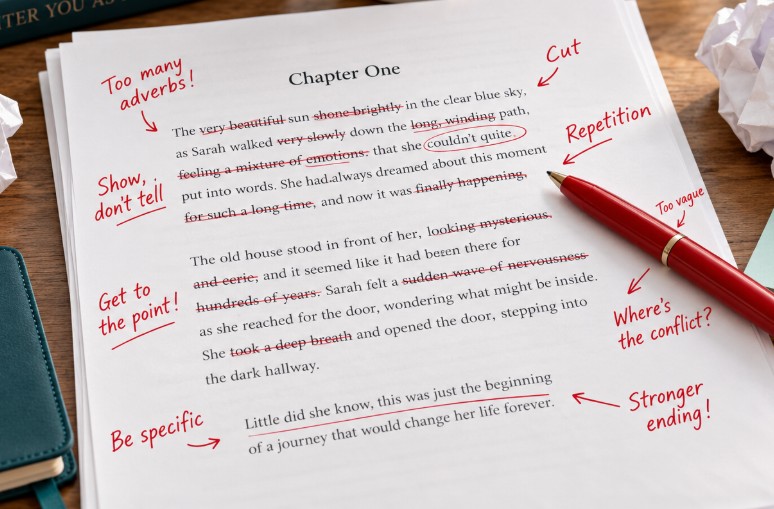
When you’re writing your first book, it’s easy to assume good writing means producing polished sentences from the beginning.
It doesn’t.
Even experienced authors revise, restructure, cut and rewrite their work.
The difference is that, over time, writers become better at recognising problems in their manuscripts.
Learning about common writing mistakes can help you spot those problems earlier — without expecting your first draft to be perfect.
Here are 12 worth watching for.
1. Starting Without Knowing What Your Book Is About
You don’t necessarily need a detailed outline before you begin writing.
But you should have some idea of what you’re trying to create.
For nonfiction, ask:
What will this book help the reader understand, achieve or change?
For fiction, ask:
Whose story am I telling, what do they want and what stands in their way?
Your answer may evolve as you write.
That’s fine.
The problem comes when a manuscript grows in several directions because the author hasn’t identified its central purpose.
How to fix it
Try describing your book in one or two sentences.
If that’s extremely difficult, your idea may need more development before you add another 20,000 words.
2. Trying to Make the First Draft Perfect
Perfectionism can make writing painfully slow.
You write a paragraph.
Rewrite it.
Change three words.
Read it again.
Then spend twenty minutes deciding whether the original version was actually better.
Meanwhile, the rest of the book remains unwritten.
Your first draft has a different job from your final draft.
Its job is to give you something to work with.
How to fix it
Separate writing from editing wherever possible.
Give yourself permission to write sentences you know you’ll improve later.
You can’t edit a blank page.
3. Beginning Too Early
This is particularly common in fiction and memoir.
Writers sometimes feel they need to explain everything that happened before the interesting part begins.
They don’t.
Your reader doesn’t necessarily need three chapters of background before reaching the event that actually sets the book in motion.
Nonfiction authors can make a similar mistake by spending too long establishing context before delivering the information the reader came for.
How to fix it
Look at your opening and ask:
Where does the reader actually need to enter this book?
Sometimes cutting the first few pages — or even the first chapter — creates a much stronger beginning.
4. Giving Readers Too Much Information at Once
You’ve spent months thinking about your book.
Your reader hasn’t.
Introducing too many characters, concepts, dates, backstories or ideas at once can make a manuscript difficult to follow.
This is sometimes called an information dump.
The information itself may be useful.
The problem is how it’s delivered.
How to fix it
Give readers information when they need it.
For fiction, weave backstory naturally through scenes.
For nonfiction, introduce concepts in a logical sequence and explain one idea before building another on top of it.
5. Telling Readers What They Already Understand
Not every emotion, action or conclusion needs an explanation.
Consider:
Emma slammed the door and marched away. She was angry.
The action has already communicated much of the emotion.
The additional explanation can weaken rather than strengthen the moment.
The same principle applies to nonfiction. Once you’ve clearly explained an idea, repeatedly restating it can make the writing feel padded.
How to fix it
Trust your reader.
During revision, look for places where the sentence after a strong moment simply explains what the reader already understood.
Try removing it.
6. Using Too Many Unnecessary Words
First drafts are often wordier than they need to be.
You might write:
Due to the fact that instead of because.
At this point in time instead of now.
Or repeatedly use qualifiers such as:
- really;
- very;
- actually;
- basically;
- quite;
- somewhat; and
- just.
None of these words is automatically wrong.
The question is whether they’re doing useful work.
How to fix it
During editing, ask:
Can I say the same thing more clearly with fewer words?
Concise writing isn’t about making everything short.
It’s about making every word earn its place.
7. Repeating the Same Words and Phrases
Writers naturally develop favourite words.
You might not notice that everyone in your novel nods, smiles or takes a deep breath until you’ve done it 47 times.
Nonfiction authors may repeatedly begin paragraphs with phrases such as:
It’s important to remember…
The key thing is…
It’s worth noting…
Repeated sentence structures can have the same effect.
How to fix it
Search your manuscript for words and phrases you suspect you overuse.
But don’t replace every repeated word with a more complicated synonym.
Sometimes the best solution is simply deleting or rewriting the sentence.
8. Writing Dialogue That Doesn’t Sound Natural
Real conversation and written dialogue aren’t exactly the same.
Real people pause, repeat themselves, wander off-topic and fill silence with meaningless words.
Reproducing all of that would be exhausting to read.
Good dialogue creates the impression of natural conversation while remaining purposeful.
Another common problem is using dialogue purely to give readers information:
“As you know, Sarah, we’ve been sisters for thirty-two years.”
Sarah probably knows.
How to fix it
Read your dialogue aloud.
Ask whether the character would realistically say those words to that particular person in that situation.
If the dialogue exists solely to explain something to the reader, find a more natural way to reveal the information.
9. Switching Point of View Accidentally
Point of view determines whose perspective the reader experiences.
Problems occur when a scene suddenly jumps from one character’s thoughts into another’s without a deliberate transition.
For example, the reader might be experiencing a scene through Ruby’s perspective and suddenly be told exactly what another character is secretly thinking.
That can be disorienting.
How to fix it
For each scene, know whose perspective you’re using.
When editing fiction, ask:
Could my viewpoint character actually know this?
If not, you may need to show the information another way.
10. Overusing Adverbs and Dialogue Tags
You’ve probably heard the advice to avoid adverbs.
You don’t need to eliminate them.
But phrases such as:
“Get out!” she shouted angrily.
may be doing more work than necessary.
The dialogue itself already communicates much of the emotion.
Similarly, writers sometimes become uncomfortable repeating said and start searching for alternatives:
exclaimed, proclaimed, articulated, announced, retorted.
Occasionally they’re useful.
Often, said is less distracting.
How to fix it
Don’t remove an adverb simply because it’s an adverb.
Ask whether it’s adding information the sentence doesn’t already communicate.
Use the same principle with dialogue tags.
11. Editing While You’re Still Making Major Structural Changes
Imagine spending hours perfecting every sentence in Chapter 4.
Then, during developmental editing, you realise Chapter 4 shouldn’t exist.
That polishing work is lost.
This is why the order in which you edit your book matters.
How to fix it
Work from large problems to small ones:
Structure → Chapters/Scenes → Paragraphs → Sentences → Grammar → Proofreading
Fix the foundations before polishing the surface.
For a more detailed process, link here to your:
How to Edit a Book: A Beginner’s Guide →
12. Assuming Your First Book Has to Be Perfect
Perhaps the most damaging of all the common writing mistakes is believing that successful authors somehow produce flawless manuscripts.
Books are built through revision.
You’ll also learn things from completing your first book that you couldn’t have learned by endlessly preparing to write it.
Your goal isn’t to prove that you’re already a perfect writer.
It’s to become a better one.
And finishing, receiving useful feedback, editing and writing again are all part of that process.
A Quick Writing Mistakes Checklist
Writing and publishing are separate stages, but understanding where your manuscript is When reviewing your manuscript, ask:
✓ Is the purpose or central idea of my book clear?
✓ Does the opening begin in the right place?
✓ Am I giving readers too much information at once?
✓ Have I explained things the reader already understands?
✓ Are any sections unnecessarily repetitive?
✓ Could wordy sentences be simplified?
✓ Am I overusing particular words or phrases?
✓ Does my dialogue sound believable?
✓ Is my point of view consistent?
✓ Are my scenes or chapters moving the book forward?
✓ Have I addressed structural issues before line editing?
✓ Am I trying to make the manuscript perfect instead of making it better?
You won’t necessarily find every problem in a single read-through.
That’s why editing a book usually happens in stages.
Don’t Let Writing Mistakes Stop You From Writing
Learning about common writing mistakes isn’t supposed to give you another list of things to worry about while drafting.
Quite the opposite.
Most writing problems can be fixed.
A weak opening can be rewritten.
An unnecessary chapter can be removed.
Clumsy dialogue can be improved.
Repetition can be cut.
A confusing structure can be reorganised.
But first, you need a manuscript.
So write the imperfect draft.
Then come back and make it better.
That’s what editing is for.
Ready to Strengthen Your Writing?
If you’re still working on your manuscript, explore more Book Writing resources from Aspire2Publish for practical guidance on planning, outlining, fiction and nonfiction, characters, plot and overcoming writer’s block.
Explore Book Writing Resources →
Continue Your Author Journey
Once your manuscript is underway, explore more Aspire2Publish guides and resources:
Book Writing
More guidance on outlining, fiction, nonfiction, characters, plot and overcoming writer’s block.
Book Editing
Learn how to revise, self-edit, proofread and strengthen your manuscript.
Book Publishing
When your manuscript is ready, follow the next stage from finished book to publication.