How to Edit a Book: A Beginner’s Guide
BOOK EDITING
Finishing your first draft is a major achievement. But a finished draft isn’t the same thing as a finished book. Editing is where you turn the manuscript you wrote into the book you intended to write.
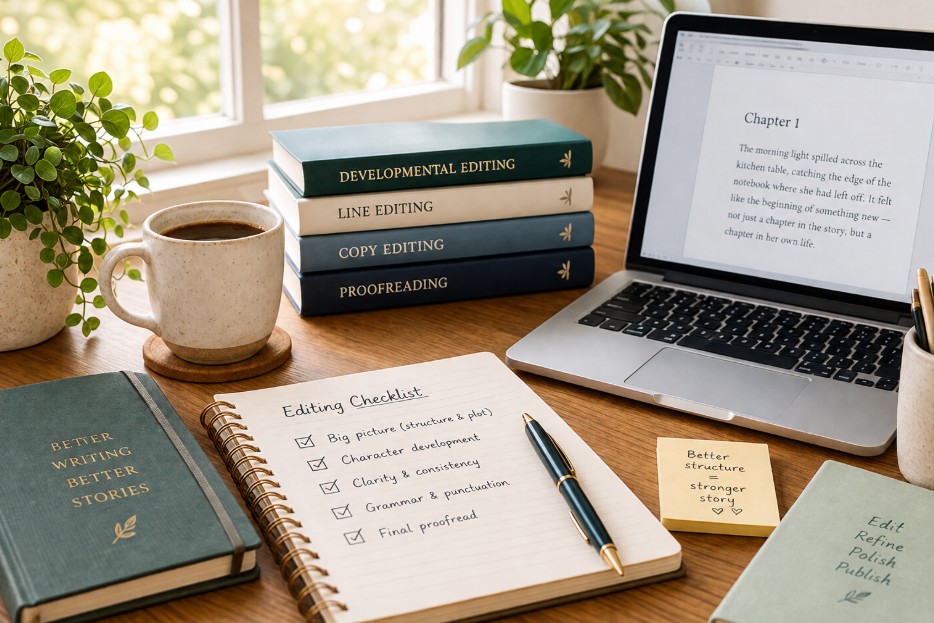
Learning how to edit a book can feel overwhelming at first. You may open your manuscript and immediately notice awkward sentences, plot problems, repeated ideas, inconsistencies and sections that simply don’t work.
The temptation is to start fixing everything at once.
Don’t.
Effective book editing happens in stages. You begin with the biggest issues — structure, content and clarity — before working your way down to individual sentences, grammar and punctuation.
This guide walks you through that process step by step.
What Does Editing a Book Actually Involve?
Book editing is much more than correcting spelling and grammar.
Depending on your manuscript, editing can involve examining:
- structure and organization;
- plot and pacing;
- character development;
- arguments and ideas;
- missing or unnecessary content;
- clarity and consistency;
- sentence structure and word choice;
- grammar and punctuation; and
- final typographical errors.
That’s why professional publishing typically separates editing into different stages.
Understanding those stages makes the process considerably easier.
The 4 Main Types of Book Editing
1. Developmental Editing
Developmental editing looks at the big picture.
Instead of worrying about individual sentences, you’re asking whether the book works as a whole.
For fiction, this might mean examining plot, character development, pacing, conflict, point of view and story structure.
For nonfiction, it could mean examining organization, arguments, reader transformation, missing information, repetition and whether each chapter contributes to the book’s purpose.
Questions to ask include:
Does the book deliver what it promises?
Is the structure logical?
Are there sections that drag or feel unnecessary?
Is anything important missing?
Will the intended reader understand and benefit from this?
These are the issues you want to solve before polishing individual sentences.he reminder later in the writing process.
2. Line Editing
Once the structure is working, you can move closer to the actual writing.
Line editing considers how your writing communicates.
You’re looking at things such as:
- clarity;
- sentence flow;
- word choice;
- repetition;
- tone;
- rhythm;
- unnecessary words; and
- awkward or confusing passages.
The objective isn’t to make every sentence elaborate.
It’s to make the writing clear, engaging and appropriate for the reader.
3. Copy Editing
Copy editing focuses more heavily on correctness and consistency.
This can include:
- grammar;
- punctuation;
- spelling;
- capitalization;
- consistency;
- factual inconsistencies;
- terminology; and
- style conventions.
By this stage, you shouldn’t still be rewriting entire chapters.
The manuscript’s structure and content should already be relatively settled.
4. Proofreading
Proofreading is the final quality check.
It happens after editing and, ideally, after the book has been formatted.
A proofreader looks for errors that remain in the finished pages, such as:
- typos;
- missing words;
- punctuation mistakes;
- duplicated words;
- inconsistent headings;
- spacing problems;
- page-number errors; and
- formatting inconsistencies.
Proofreading is not a substitute for editing.
It’s the final check after the editing work has already been completed.
How to Edit a Book Step by Step
Step 1: Put Your Manuscript Away
One of the simplest editing techniques is also one of the hardest:
Stop looking at your manuscript for a while.
Immediately after writing it, you know the material too well.
Your brain remembers what you intended to write, which makes it surprisingly easy to overlook what is actually on the page.
Give yourself some distance.
That might mean several days or several weeks depending on your timeline.
When you return, you’ll be better positioned to read the manuscript as a reader rather than its creator.
Step 2: Read the Entire Book Before Editing
Try not to start rewriting page one immediately.
First, read the manuscript from beginning to end.
You can make notes as you go, but concentrate on identifying patterns rather than correcting every problem.
Ask:
Where did I lose interest?
Where was I confused?
Which sections feel strongest?
What feels repetitive?
Does the book deliver what I promised the reader?
What is missing?
You want to understand the manuscript before you start dismantling it.
Step 3: Fix the Big Problems First
This is one of the most important principles when learning how to edit a book.
Don’t spend twenty minutes perfecting a paragraph that you may later delete.
Start with developmental issues.
You might need to:
- move chapters;
- delete unnecessary sections;
- add missing information;
- rewrite scenes;
- strengthen characters;
- reorganize arguments;
- clarify the book’s purpose; or
- change the order in which information appears.
Think of it as renovating a house.
You wouldn’t choose the cushions before deciding whether a wall needs to come down.
Get the structure right first.
Step 4: Edit One Chapter at a Time
Once the overall structure works, make the process smaller.
Instead of thinking:
I need to edit my entire book.
Think:
I’m editing Chapter Four today.
Work through each chapter methodically.
Check that it has a clear purpose and contributes something necessary to the book.
Then look at paragraphs.
Then sentences.
Moving from large to small prevents editing from becoming an endless cycle of changing random things throughout the manuscript.
Step 5: Cut What the Book Doesn’t Need
Writers naturally become attached to their words.
But something can be beautifully written and still not belong in the book.
Look for:
- repeated explanations;
- unnecessary backstory;
- filler;
- overly long examples;
- scenes that don’t advance the story;
- tangents;
- excessive description; and
- ideas you’ve already communicated elsewhere.
Ask a simple question:
Would the book be weaker if I removed this?
If the answer is no, consider cutting it.
Step 6: Strengthen Your Writing
Now you can start working sentence by sentence.
Look for places where your writing could be clearer, tighter or more engaging.
For example:
Before:
It is important to remember that there are many different ways in which an author might potentially approach editing their manuscript.
After:
Authors can approach manuscript editing in several ways.
The second version communicates essentially the same information with less friction.
Look particularly for unnecessary qualifiers, repeated words, long sentences and phrases that don’t add meaning.
Don’t remove personality in pursuit of brevity, though.
Good editing should strengthen your voice, not erase it.
Step 7: Check for Consistency
Books are written over weeks, months or sometimes years.
Things change along the way.
A character’s eyes may mysteriously change color. A term might be capitalized in Chapter Two but lowercase in Chapter Eight. You might write “eBook” on one page and “ebook” on another.
Create a simple style sheet to record decisions about:
- character names;
- dates;
- places;
- capitalization;
- spelling;
- terminology;
- numbers;
- abbreviations; and
- formatting conventions.
This becomes increasingly useful as the manuscript grows.
Step 8: Read Your Book Aloud
Reading aloud changes how you experience your writing.
Your eyes can glide over an awkward sentence.
Your mouth usually can’t.
Reading aloud can reveal:
- sentences that are too long;
- unnatural dialogue;
- missing words;
- repetition;
- awkward phrasing; and
- passages that simply don’t flow.
You don’t necessarily have to read an entire 80,000-word manuscript aloud in one sitting.
Work through it chapter by chapter.
Text-to-speech software can also help you hear problems you’ve stopped noticing on the page.
Step 9: Get Another Reader
Eventually, you become too close to your manuscript to see everything yourself.
This is where outside feedback becomes valuable.
Depending on the stage of your book, that might come from:
- beta readers;
- critique partners;
- knowledgeable readers;
- sensitivity or subject-matter readers; or
- professional editors.
Be clear about the type of feedback you need.
Asking someone:
“What do you think?”
may produce:
“I liked it.”
Instead, ask specific questions.
Was anything confusing?
Where did your attention drop?
Did anything feel repetitive?
Was there anything you expected the book to cover that it didn’t?
Useful feedback is actionable.
Step 10: Decide Whether You Need a Professional Editor
Not every author has the same budget or publishing goals.
However, self-editing and professional editing perform different roles.
You wrote the book.
That makes you uniquely qualified to understand what you’re trying to achieve — but it also makes you unusually good at overlooking things because you already know what they’re supposed to mean.
A professional editor brings distance and specialist expertise.
If your budget allows, determine which type of editing your manuscript actually needs rather than simply hiring someone offering “book editing.”
Ask what their service includes, request a sample edit where appropriate and make sure their experience suits your genre or subject.
Step 11: Proofread the Finished Book
After you’ve completed your major revisions, line editing and copy editing, you’re nearly there.
But don’t skip the final proofread.
Ideally, proofread the book in the format readers will actually receive.
For a print book, that means checking the formatted interior or physical proof rather than only the original Word document.
Look at more than spelling.
Check:
- chapter headings;
- page numbers;
- headers and footers;
- paragraph spacing;
- fonts;
- scene breaks;
- blank pages;
- table of contents;
- images and captions; and
- links in digital editions.
At this point, resist the temptation to begin major rewriting again unless you’ve discovered a genuine problem.
The purpose of proofreading is to catch errors, not restart the editing process.
A Simple Book Editing Checklist
Before calling your manuscript finished, check that you can confidently tick off:
✓ I have read the complete manuscript as a whole.
✓ The book has a clear purpose and intended reader.
✓ The structure works.
✓ Each chapter contributes something useful.
✓ Unnecessary repetition has been removed.
✓ Plot or argument inconsistencies have been addressed.
✓ Sentences are clear and readable.
✓ Spelling, grammar and punctuation have been checked.
✓ Names, terminology and formatting are consistent.
✓ I have received appropriate outside feedback.
✓ The manuscript has been proofread.
✓ The formatted book has received a final check.
Then you’re ready to move on.n that stage one step at a time too.
Editing Doesn’t Mean Making Your Book Perfect
One of the dangers of learning how to edit a book is discovering that you can always find something else to change.
A sentence could always be rewritten.
Another word could always be considered.
Another paragraph could always be rearranged.
At some point, editing stops improving the book and starts preventing you from publishing it.
Your goal isn’t perfection.
It’s a book that is clear, polished, professional and ready for its intended reader.
Work from the biggest problems to the smallest.
Complete one editing stage before moving to the next.
And eventually, give yourself permission to call the manuscript finished.
Ready to Strengthen Your Manuscript?
Once you’ve completed your first draft, working through your manuscript systematically can make the editing process far less overwhelming.
Explore more Book Editing resources from Aspire2Publish for practical guidance on self-editing, proofreading, working with professional editors and avoiding common writing mistakes.
Explore Book Editing Resources →
Continue Your Author Journey
Once you’ve worked through the editing process, explore the next Aspire2Publish guides and resources:
Book Writing
Need to revisit your manuscript? Explore guidance on structure, characters, nonfiction, plot and strengthening your writing.
Book Formatting
Once your manuscript is edited, learn how to prepare a professional interior for print and Kindle.
Book Publishing
When your manuscript is polished and ready, follow the steps from finished book to publication.